Showing posts with label green Pomona. Show all posts

Tuesday, April 22, 2008

Happy Earth Day


I couldn't get Mr. Big to wear his earth shirt today, so I painted the blog green instead.

Many pockets of the Pomona Valley are embracing the green movement. Unfortunately, the City government of Pomona is not leading -or even following- the way, but here's a few local people and groups that should give us hope that the City might one day see the light:


Cal Poly's Center for Regenerative Studies - a unique program that is grooming future leaders of sustainability. Cal Poly has reached out to the City in the past, but so far this is, for the most part, an untapped resource. Grants and for-credit programs could change all that. So could just talking to each other. Thanks to Ren for this photo.


Pomona Regens - three "intentional community" houses of sustainable living here in Lincoln Park. The Regens held an open house a couple weeks ago, and the Goddess had the distinct pleasure of meeting an interesting and thoughtful assortment of the residents. I'll be posting more on Scott's talk about "Urban Gardening for Lazy People." For now, here's the picture as a teaser.

Claremont High School's Teen Green. Pomona students are members too. Weren't you saying that you were going to be doing something like this at Pomona High, Andrew?


John Greenlee - the Ornamental "Grass Guru" of Armstrong Nurseries and Pomona boy- done-good. The picture is a garden he designed for an exhibit in San Francisco. And then there's that secret garden of his somewhere in Pomona...John has been talking about killing your lawn (or replacing it with a low water version) for 30 years, but popular culture has just now caught up with him.


Ted Pugh - the "Pomona poet" who was writing green his whole life, including a time when such things were considered not only unfashionable, but downright counter culture. I imagine the fairies he kept in his forest looked a bit like this.


Coates Bicycles - they've been peddling bikes for over 70 years. Now, when pedaling bikes is being embraced as the way of the future, they are being forced out of business by a very-out-of-touch-with-anything-green-and-progressive City of Pomona.


Here's the often photographed Judge Gallup, one of Pomona's early characters about town. He serves as a visual reminder of Pomona's turn-of-the-century roots as a bike culture. Thank you to the Pomona Library digital collection.


The Claremont chapter of Food Not Lawns, which recently put in this "front food" in Pomona's Lincoln Park. Mmmm Mmmm good.


Lastly are all the people whose names I don't know who are doing their part to help Pomona sustain itself for our children. The nameless are typified by the elderly woman who painstakenly planted a colorful drought tolerant garden on the side of her home, just steps away from the gritty corner of Towne and Mission. It's not pictured, because I want you to actually get on your bike and check it out. (It's on the southwest corner, to the side of a white wall with a flower imprinted on it.) Guaranteed to put a big, earth day smile on your face. As for me, I'm just glad I'm done with this post!

THE END

Wednesday, March 12, 2008

Pomona Council Compost


RAIN or SHINE: This Saturday, March 15, 2008 at 10:00 a.m. is the community tour at Cal Poly Pomona's Center for Regnerative Studies. Parking and admission is free. Click on visitor information here for directions to the Center's parking lot. This will be informative and kid friendly, and if even a handful of us attend, it could be a starting point for grassroots efforts to make Pomona more green and liveable.

Thanks to Ren for creating today's visual: a re-use of the deserted gas station at Alvarado and Garey. Click on the photo to blow it up. The imaginary "Pomona Council Compost" is home to communal composting, a virtual community garden and a flyer-starved cork bulletin board. Hey that's the Goddess of Pomona van parked out front. Don't worry, I promise not to park there longer than 72 hours at a time :0 The planters may look familiar to regular readers...they've been Greenlee-ized.

Imagine how many Lincoln Park residents would get out of their cars and walk to the local Stater Bros., if there is actually a community scene at that corner. And wait, Ren will soon be creating a cyber frozen yogurt shop slash virtual coffee house in the vacant restaurant across the street.

My Pomona native friend A told me that the restaurant and gas station at Garey and Alvarado have been vacant for at least 15 years. It's been five years that I have been fantasizing about the possibilities each time I pass by. The California property boom has come and gone, yet these two vacant corners remain at one of the most visible and promising Pomona intersections.

Over the weekend, I got the chance to speak with Justin, the son of the owner of the gas station property. He explained that his father purchased the property about four years ago with the intention of opening up an auto repair shop. He said that neighbors were against the shop opening up due to noise concerns. He said that the City would not allow the shop, so the property has sat vacant. Justin said that the property is currently on the market.

I spoke to Justin about the idea of a community garden there, which would be a win-win situation -- making the property more attractive and thus more valueable. Justin was very understanding, but I got the feeling that dad would be a hard sell. Justin took my number and agreed to speak with dad about the idea. To his credit, dad can often be seen cleaning up trash from the empty lot.

Perhaps it would be more worthwhile for dad if he was offered rent money for lending his property to the community good. Maybe working with Cal Poly, we could get a grant for a sustainability project there -- obviously some project that would be safe on land that previously housed a gas station.

In any event, I hope to see you on Saturday.

THE END

Saturday, March 01, 2008

Mark Your Calenders


Dr. Kyle Brown will give a tour of the Cal Poly Pomona Center for Regenerative Studies on Saturday, March 15, 2008 at 10:00 a.m. For directions and a map, go to their website (under "for visitors"). People do not need to pay for parking on that day, if they park in the Center parking lot.

I will do a reminder post as we get closer to the 15th.

THE END

Tuesday, February 26, 2008

Thinking Green(lee)


About three weeks ago now, I got an email with the subject line, "Here to serve my goddess." Since my family has not had a working bathtub for six months, I opened the email with visions of free plumbing work in our future. Turns out that the services being offered were photographic in nature. Specifically, photographs of any place, or anybody, in Pomona. And so it came to pass that Richard E. Nunez, most westward Second Street artist and life-long Pomona resident, has been doing his part to keep the blog pretty -and pretty active- with a regular stream of photographs.

Today's photo was his idea and creation. Here's the complete credits:

Art work and creative/ technical direction - Provided by Richard E. Nunez

Original Photography - Shot by the Goddess of Pomona

Styrofoam cup (look close on the right hand top corner of the sign) - Donated by a Pomona homeless person

Black and White "plant a meadow" poster inset - Ripped off (I mean recycled) from John Greenlee

Groundcover - Courtesy of John Greenlee (it's his trademark ornamental grass)

Fence- made possible by the City of Pomona Historical Ordinance (please give me about 4 blocks leeway for this one to work)

Dream - made possible by readers like you, alongside members of Covenant Methodist Korean Church

The update on the Towne Avenue garden project is that I am in communication with a Cal Poly Pomona landscaping architecture student, one of the same guys who did the Tri City garden. For whatever reason, it took a long time to actually get his contact information in order to get in touch with him. He was excited about the project and agreed to check on the site and give us a break down of how and what we should plant there. When I told John Greenlee's assistant Carlos about the project, he offered to donate plugs from their nursery. Slowly, but surely, it's coming along.

THE END

Monday, February 25, 2008

Pomona's Green Ascent


I recently interviewed Dr. Kyle D. Brown, director of Cal Poly Pomona's Center for Regenerative Studies on how Pomona can become a greener, more sustainable city.

I'm very exicted to post the interview on the blog. Because of it's length, the interview appears after the jump.

GoP: For those unfamiliar, can you introduce yourself and explain what Cal Poly Pomona's Center for Regenerative Studies is all about?

KB: I am Director of the John T. Lyle Center for Regenerative Studies at Cal Poly Pomona University, as well as an Associate Professor of Landscape Architecture. The mission of the Center is to advance the principles of environmentally sustainable living through education, research, demonstration and outreach. While our goal is one of advancing sustainability, that is meeting the needs of the present without compromising the ability of future generations to meet their own needs, we believe that the best way to achieve this is by designing community systems to restore, renew, revitalize or regenerate themselves. This is why we use the term regenerative in our title.

Located on 16 acres within the Cal Poly Pomona campus, the Lyle Center is designed to demonstrate sustainable living and provide a laboratory for cutting-edge research. The Center demonstrates a wide array of regenerative strategies, including passive-solar building design, energy production technology, organic agriculture, and native plant community restoration Our Master of Science program prepares students to address environmental challenges facing society in the 21st Century.

GoP: Does your center have any particular short and/or long term ideas on how to make Pomona a greener, more sustainable city?

KB: Our approach to sustainable communities emphasizes attention to the systems that serve the community. The most basic physical systems are food, water, energy, shelter and waste. There is great opportunity for sustainable strategies for each of these systems within Pomona. But we are also believers in the notion that sustainable strategies need to be embraced, and even emerge from the community itself. So I hesitate to present a list of ideas that Pomona should embrace. Instead, I would urge the community to ask the following questions:

What are the sources of food serving local communities? In what ways can the community increase local agriculture to provide affordable and nutritious food that is free of harmful additives (e.g. pesticides)? This may lead to ideas like more local community gardens or produce-sharing networks among backyard gardeners.

What are the sources of drinking and irrigation water? In what ways can the community reduce the amount of water they use, particularly water that is imported from great distances? In what ways can the community work to ensure that rainwater is effectively utilized for irrigation and that it is not contaminating the environment? These questions may lead to ideas like water-conserving landscape designs, rainwater capture, or biological approaches to rainwater treatment, such as constructed wetlands.

What are the sources of energy serving local communities? In what ways can the community 1) minimize the amount of energy it uses, and 2) seek to produce or promote alternative renewable energy sources? A significant consumer of energy is transportation, so what potential exists to reduces automobile transportation? Energy consumption is directly related greenhouse gas emissions, so communities concerned with this issue have been focusing on this system in particular. These questions may lead to solar energy initiatives, advocacy for alternative transit or walkable communities.

What kinds of material and energy go into construction of the built environment within the community? What alternative building materials and building designs could be utilized to minimize the use of energy, non-renewable materials, and materials with high embodied energy (e.g. materials that require a lot of energy to produce, extract or transport). These questions may lead to guidelines or assistance for new construction or renovation.

What waste is produced by the community? How can waste, be reduce, reused, or recycled? In what ways can waste materials be utilized as a resource? We're pretty good in this country at recycling, but that's really the third option in the mantra of reduce, reuse, or recycle. Initiatives could be focused on everything from backyard composting to economic development initiatives to create products from waste materials.

You can imagine, there are a variety of ideas that could emerge to creatively address environmental problems within the community. Some may be local in scale, in terms of individual residents taking action. Others may be better addressed at the neighborhood level, city-wide, or beyond the city to the entire region. It's usually easier to begin locally.

GoP: How receptive has The City of Pomona been in the past towards instituting sustainable practices? What are your expectations for the future? Am I right that Pomona, being that we house your campus, is uniquely suited to take advantage of your students, programs and resources --and possibly become one of the greenest city's around? If the City has not been receptive (which frankly looks like the case from the outside, what's your guess as to why?)

KB: I have been involved with the City off and on over the years I've been at Cal Poly Pomona, both through the Lyle Center and through the Landscape Architecture Department. I think one of the challenges has been the high rate of turnover experienced within the City Departments over the years, which makes it difficult to establish long-term working relationships. There has been great interest around some issues at various points in time, but nothing long-term. Cal Poly Pomona is a great potential resource, and I hope the City and the University continue to explore connections. I think ultimately it takes a commitment of resources on both ends and that hasn't really emerged yet.

GoP: Since your department is a big believer in grass roots activity, how can we concerned citizens work with your program to start instituting more sustainable practices? And on that note, what would be a good place to start? Are there specific grassroots activities going on in Pomona as we write that you'd like to mention?

KB: I do think that in order to build up to that commitment of resources on the part of the City, it will take some grass roots mobilization. I would suggest starting small, developing a strategy for addressing one of the questions posed above. A good starting point might be a tour of the Center to learn more about what we're doing, which may lead to some community brainstorming. Many of us live in Pomona and are interested in this issue, so the Center is likely a willing assistant in this process in a limited way. Ultimately, the long-term commitment of resources from Cal Poly Pomona's end will hinge on funding, which may be available in the form of grants or similar programs.

I will mention two things happening that are happening in Pomona that are good examples or have good potential.

1. You profiled the work of a couple of our students back on January 15th, 2008, and their work at the tri-city mental health center. This kind of community garden is very exciting and represents one kind of connection between Cal Poly Pomona and the community (although these guys have been doing this mostly on their own). The Center has been involved in the past in community gardening in the Angela Chanslor neighborhood and other locations in the City.

2. Cal Poly Pomona's President, Dr. Michael Ortiz, recently signed the President's Climate Commitment, a voluntary pledge of university leaders from around the country to make their campuses "carbon neutral" to combat climate change. A key component of this pledge is that the University must demonstrate leadership within the community in confronting climate change. The climate task force convened by the President is currently brainstorming about ways in which this leadership will be demonstrated, but community projects and programs seem to be an excellent opportunity. So this could be important in building the commitment from Cal Poly's perspective.

GoP: It seems that in order to make some inroads in sustainability, you need to work with the local city administration. How does your center "play politics" when it comes to instituting programs in Pomona? How does your program equip students to deal with bureaucracy as they graduate and go into the world?

KB: This is critical. Our students take courses in coalition building, policy analysis and what I would describe as deliberative practice. We learned a long time ago at the Center that the community is the most important element in a sustainable plan. You can develop the most sophisticated technology or physical system to achieve sustainability, but if the community lacks the interest, the need, or the capacity to operate it, then it will be abandoned, and thus be utterly unsustainable. So the kind or practice you describe is integral to our education program and to our approach. It's one of the things I believe that makes us unique from other academic programs in environmental science or environmental studies.

GoP: Are there lessons to be learned from others cities, like Santa Monica and Portland, that have been able to insistute more sustainable practices to help us do it in Pomona? And btw, are there other local cities, like Claremont (the C-word around here) that have taken more advantage of your programs than Pomona has?

There are some good models out there, but again, what works in Santa Monica may not work in Pomona. Often, communities cited for their environmental ethos tend to be affluent and highly-educated. At the Center, we would argue that communities that most need sustainable strategies are lower-income and often marginalized. It's no secret that pollution, flooding and other negative affects of unsustainable development adversely affect low-income, marginalized communities, so one could argue that this is where the need is greatest. Further, sustainable practices are, almost by definition, less resource intensive than unsustainable ones. So it makes economic sense to be sustainable, particularly if you have limited resources.

We serve many communities in Southern California, as well as work we are doing internationally. Yes, many groups from Claremont have visited the Center, but many groups from Pomona have over the years as well.

GoP: Another local blog recently talked about low-cost composters available in other cities. Can you explain the value of composting? Any ideas on how to make it a more wide spread practice (communal composters, etc.)

KB: Composting, if you have the need and ability to use it, is one of the better activities you can practice. It reduces organic waste that may go to landfill, and provides an organic (non-petroleum based) method of fertilizing your garden. There are numerous methods for composting green and vegetable food waste that can be applied in backyards. You can purchase sophisticated units that aide you in turning the compost, or you can do what I do: buy some welded wire mesh and tie it into a 5-foot high cylinder. This works quite well and is very cheap. At the Center, we do both large and small-scale composting. The best solution depends on the need.


GoP: What do you have to say to naysayers who insist that Pomona's working class population is not interested or ready for more sustainable practices?

KB: See my answer to #6 above. As an aside, we currently have a project addressing sustainable housing in informal settlements on the outskirts of Tijuana, Mexico. We have challenged students to develop strategies for providing low-energy shelter that is comfortable and inexpensive. They have been exploring mostly waste products as building materials to keep the cost down. We actively work with the community in Tijuana, which is much more poor than Pomona, and they are all into it. They like that they are helping the environment, but the solutions also improve their quality of life. When that connection is made, everyone is on board.

GoP: Some of the issues I'd like to see addressed - comment if they are something your center is particularly concerned about addressing: lack of bike paths (and hearing that the City was offered free bike paths recently and turned it down) added floridation in water at levels toxic to babies, regular herbicide use by the City and private residents, wide-spread leaf blowing into the air, gas station abandonment, inability to "shop local", pedestrian unfriendliness, unused empty lots that could be greened or used as edible gardens, the ongoing and frequent water use by local lawns, and an ongoing search for local farms and dairies.

KB: Bike Paths. My students in Landscape Architecture actually developed a conceptual bike path plan for the City back in about 2000. This is an example of one of those things affected by turnover at the City. I don't think anyone we worked with is there anymore, and I doubt anyone at the City has that work anymore.

Herbicide and leaf blowers. This is interesting to us, particularly given our climate commitment. There are many who believe the landscape can be effective in sequestering carbon from the atmosphere, because that's what plants do all day as part of the photosynthetic process. So it is receiving lots of attention as a resource for reducing atmospheric carbon, thus offsetting the effects of global warming. However, if you look at the energy inputs (water, herbicide, fertilizers, and gas maintenance equipment) that go into maintaining many park and lawn landscapes, these emissions likely more than offset any benefits of carbon sequestration by the plants. So our interest is how do you design a landscape that optimizes carbon sequestration over time, and minimize resource inputs. A number of us (myself included) at Cal Poly Pomona (and elsewhere) are studying this right now.

GoP: For those interested in learning more about your center, is it open to the public? You have offered to give a tour of the facility. We should set a date for it and announce it on the blog.

KB: We should do a community tour. I'd be glad to lead such an event. I suppose a Saturday or Sunday would be best. If you want to do it soon, maybe the weekend of March 15-16, 22-23, or 29-30 would be best. But later in the spring is fine too. Let's set something up.

GoP: To end on a high note, please tell everyone what city you proudly call home?

KB: I'm proud to live in Pomona (most days).

GoP: Yeah, me too. Thank you for your time. I'll open it for comments about any of those dates, after which time we'll pick a day and spread the word.

Today's photo: the non-fictional, green-lit escalator at the Seattle Public Library.


Thursday, February 21, 2008

The Search for the Pomona Secret Garden


Thanks to the Foothill Cities blog for alerting me to the L.A. Times article about Pomona's secret garden, and the men who planted it.

I am wondering where the secret garden is? Anyone know where the Mermaid House is located? I've put a message into Dawn at the Garden about it, as John Clifford did not know. EVen David Allen was stumped enough to ask me.

I logged on the Greenlee Nursery website for their Chino nursery and found this picture of the man himself, John Greenlee(today's blog photo). I have sent email to John Greenlee, asking him some questions and inviting him to visit the blog.

Their website is worth a glance. It acknowledges John's free spirited ways: "You are welcome to visit the nursery at any time...but there is no guarantee that anyone will be in the office to assist you for purchases."

John's clients include Tim Curry, Eric Clapton, as well as David Duchovny and his lovely wife Tea Leoni. He also "did" the grass for Jurassic Park II. He is the author of the Encyclopedia of Ornamental Grasses. And he shares my view on herbicides and pesticides. Wonder if he can share any ideas with us for community gardens. Mostly, I'm wondering if we can convince him to stay.


THE END

Sunday, July 16, 2006

Think Global = Buy Pomona


The newest food concept to be gaining ground is that of buying food that has been locally grown. This is not a new concept; just new to our generation. The inspiration for this post was my husband telling me about an interesting website called www.100milediet.org. The website chronicles a couple who ate nothing but food grown within 100 miles of their home for one year. They saved money, lost weight, ate fresher food, supported their local economy and helped the environment -- all in one fell swoop.

Getting our children in touch with Mother Earth, specifically teaching them where the food they put in their body comes from, is a great investment in the future. THEIR future. It should be easy, since kids naturally love learning about gardening, farms and moo cows. It's us parents who need to expose them.

As a kid growing up in suburbia, I remember how exotic it seemed that our neighbors had milk delivered to their door by the local dairy. I don't see that anymore, even tho I can smell the nearby dairies from my house some days. Over time, food travels from further and further away. As a result, packaging and processing has increased.

I didn't know much about food until I had trouble getting pregnant and did some research. We discovered how important food can be to the function of basic organs and systems. Mr. Big is a product of that knowledge. I suppose it's not suprising that when we go to the grocery store, Mr. Big has become known for grabbing a box of food and assuring me that he's "just checking the ingredients." It makes me laugh, but I'm also glad to be instilling that awareness. Even before he can read!

Okay, enough preaching here. If you want to feel guilty, tho, go to the "foot print" website where they estimate how many acres of land are required to support your lifestyle. After answering a few questions, I was told my lifestyle requires 17 acres to sustain it. The website points out that the world's resources only work out to 4.5 acres per person. 17 is better than the average, but still leaves lots of room for improvement. Check it out here, if you dare: www.myfootprint.org.

I have to thank my friend Joy, mother of two boys under 5, for her contributions to this post. She used to live in Pomona, but now she lives in [bringing voice to a whispery growl] Upland. She's still a Pomona person at heart. She's been calling me to rattle off various websites with information on eating locally. Additionally, she's been contacting local farms to find out what they offer and whether they sell to the public. There's hope that we can find local suppliers of things most of us would like to buy all the time: like organic cow and goat's milk and dairy products, hormone/antibiotic-free meats, and organic or pesticide-free fruits and vegetables.

Henry's Market has just this week started labeling certain foods as local, which helps out a lot when you are shopping with an impatient (okay, bratty) child. I think this type of labeling is the way of the future, which means the larger chain stores will start doing it in another 5 years or so. If you haven't been to Henry's, they are in Chino Hills and Rancho. They offer healthier options than the major chains at moderate prices. Having once shopped at Whole Foods myself, Henry's proves that a health store doesn't have to be a rip off. They always have good sales on produce. Our favorites there are the nitrate-free chicken hot dogs and the Apline Village cinammon bread. (oh and hey, it's locally made). As a parent, I appreciate Henry's playcar cart. I'm disappointed that they have never replaced their childsize shopping cart that someone stole a while back. Here's their website: http://www.henrysmarkets.com/app/henrys/index.php

To find local ranches and farms, stay posted to this site. You can also go to the following website to check for local resources: www.localharvest.org

To read about an organic farm in El Monte staffed by innercity kids, go to www.ewent.org

To read about a farming family in Pasadena who produces 6,000 pounds of food a year on one tenth of an acre, go to their ultra beautiful website (they're in Pasadena after all) at www.pathtofreedom.com. They only spend $50 to $100 on food other than what they raise at home. Wow. You're right, Joy, they have great links on this page. And great articles too, like this one entitled "Baking your own bread for the clueless but curious": http://pathtofreedom.com/resources/index.php?option=com_content&task=view&id=220&Itemid=51

Path to freedom also sells an $18 book called Greenopia, the Los Angeles edition, with local information on "green" businesses. The book provides help trasitioning to a more sustainable lifestyle. You can also just go to www.greenopia.com.

Joy recently went berry picking with her boys at Riley Farm in OakGlen. I personally don't know if I dig the Patrick Henry theme, but berry or apple picking as a day trip sounds like fun. Their website is at www.rileysfarm.com. Seems there's some sort of family fued going on between different factions of the Riley family in Oak Glen, so be sure you have the right directions. Seems it all started over the muskets.

The town of Pomona is home to trailblazers in the area of sustainability. In part, because of Cal Poly Pomona's Regenerative Studies Program.

http://www.csupomona.edu/~crs/

There are three houses in Pomona's Lincoln Park which are dedicated to environmental sustainability and responsibility. The occupants of the homes are graduates of Cal Poly's Regenerative Studies Program. Collectively, they call themselves the Regenerative Co-op of Pomona. In addition to their gardens and projects like their grey water pond, they host community events on sustainability. Their website is at www.regen.org. You can sometimes see them driving around in their electric cars. The Pomona regens made the news back in 2003 when member and peace activist Josh Connole was wrongfully arrested and accused of being the West Covina Hummer Arsonist. In the end, someone else was charged for the crime. As for whatever became of Josh? In 2005, he was awarded $100,000 for all that he went through. One of the FBI agents admitted that she had told the arresting officer that there was not cause to arrest Josh, yet the officer did so anyways. It appears that Josh was targeted because of his political and environmental views. Pretty scarey. As of 2005, Josh was reported to be living in Oregon. I met him briefly on a Pomona home tour. He seemed soft spoken, funny and polite as we shared a few words about one home's bad remodel job.

The Pomona Regens are likely a great resource for information on local food and lifestyle, since that's their thing. Hopefully one of their members will log on the blog and contribute some knowledge.

Saturday, July 08, 2006

The Ungreening of Pomona


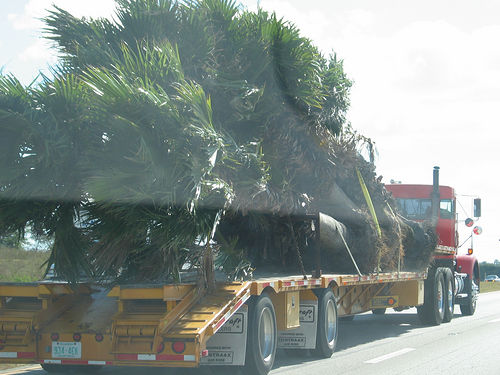
Thursday night I attended a community meeting at Lincoln Park that was slated to be about "historic tree removal." KInd of a peculiar title for a meeting, since I thought that living in a historic district meant our trees were protected. Turns out that a couple of weeks ago, several healthy, old growth palm trees were yanked out of the ground and taken away from the Lincoln Park Historic District. When concerned citizens approached the private contractor who was extracting the healthy trees as if they were rotting teeth, the company said they were working at the direction of the City. Apparently, the City deemed that the trees were an "imminent threat" to the power lines above, so no official notice was given before the Monday morning yanking took place. (As for what qualifies as "imminent," well the City later revealed they've known about the problem for six years.) Resident witnesses allege that in addition to the trees under the power lines, another healthy tree that was nowhere near a power line was taken out and away by the contractor. It was suggested that because there was no City worker there to supervise the overall tree yanking, perhaps a mistake was made. Ooops! By now, it's in some other lucky city's ground, perhaps Claremont even.

At the meeting, the City official boasted that a "deal" had been worked out where the private company removed the trees for FREE in exchange for the right to sell the tree and keep the profit. Mature palm trees fetch a hefty price on the open market, much higher than a reasonable price of removal, so this sounds more like a swindle than a deal. The City claimed that the company told them it would have otherwise charged $4,500 for each tree they removed. Even at that unreasonable removal price, I believe most palm trees are worth more. An old neighbor in Los Angeles was offered $15,000 for his front yard palm tree, which he (not so promptly) declined. The City rep at the meeting said the City felt "lucky" to find someone to cart these trees away for us. Huh? This is literally like thanking someone after they rob you.

The icing on the cake is that there is still a dead palm tree in this exact same location, but the company refused to remove that one, saying the dead one was the City's responsibility to remove. Too bad I don't have a digital camera yet, or the dead one would have been the photograph for this post.

The meeting was filled with angry people who couldn't believe that the City gave away both our trees and our profits to a third party. Sometimes anger is not a bad thing. One of the main reasons why many of us live in Lincoln Park is not only because of the awesome architecture, but because it is so lush and green here.

Several times during the meeting the City rep referred to certain trees as "junk trees," meaning those grown by accident, like when a bird drops a seed that eventually grows into a tree. I have one of those in my backyard, and it is about 4 stories high. Several people corrected him that there are no trees that are junk, especially those that have been in the ground for several generations. The City rep said that the City would work hard to protect "specimen" trees, but that a "junk" tree was not worth the same effort. If I remember correctly, the involved trees were Mexican Fan palm trees, which fell into the City category of "junk" trees. Isn't that like the Humane Society saying it's okay to euthanize mongrels, as long as they save the purebreds? Not cool.

I did learn something new, however, and that is that there is indeed a problem with So Cal Edison needing to keep their power lines free of obstruction from trees and their branches. There are certain palm trees, mainly the shorter, stumpier ones like the Mexican Fans, that can grow into the lines and become a hazard. Other trees can grow into the line, but are not a problem. So. Cal. Edison is supposed to be notorious for bad hack jobs of trees that breach their power lines. So. Cal. Edison has been known to "top" trees that get to be too much of a nuisance to keep trimming, which is why the City intervenes first in order to save the trees from certain death. Both So. Cal. Edison's safety needs and the City's safety needs trump the historic ordinance, that's why they have the right to remove trees in an historic area. That part seems reasonable to me. I know that some residents have had to take out diseased trees, but they replace them with new trees and no greenery is lost.

Underground power lines would solve this issue. When asked by the residents, Councilwoman Lanz refused to even dialogue with Edison about the possibility of putting the lines underground in this area as a way of saving the historic trees. The consensus in the audience was that this is a conversation that needs to happen, before it is simply ruled out as an impossibililty. I'll bet money that at least part of Pasadena's Historic areas have been able to get underground power lines installed to protect their historic trees.Whatever happens, it was agreed that the City won't ever yank out trees without proper notice, and that we will find a way to replant these trees elsewhere in Lincoln Park, rather than giving our green and monetary riches away.

Several attendees, including a very vocal, local nursery owner, offered to provide the City with names and numbers of companies who perform economical tree removal. The nurserer named one company that removed similar trees in another City for $700.

btw, other trees on the short list for removal are the palm trees on the northwest corner of Jefferson and Gibbs. These palm trees are overlapping magnolia trees, so these palms will actually be better appreciated somewhere else.

For the sake of our oxygen and shade-deprived kids, let's keep on hugging those trees -- wherever we are in Pomona. Hopefully the City now gets it and we won't need to install alarms on our trees to alert us of impending TTTTIIMMMBERRRRRRRRRRRRR.